
Philip Roth's Ghost Writer

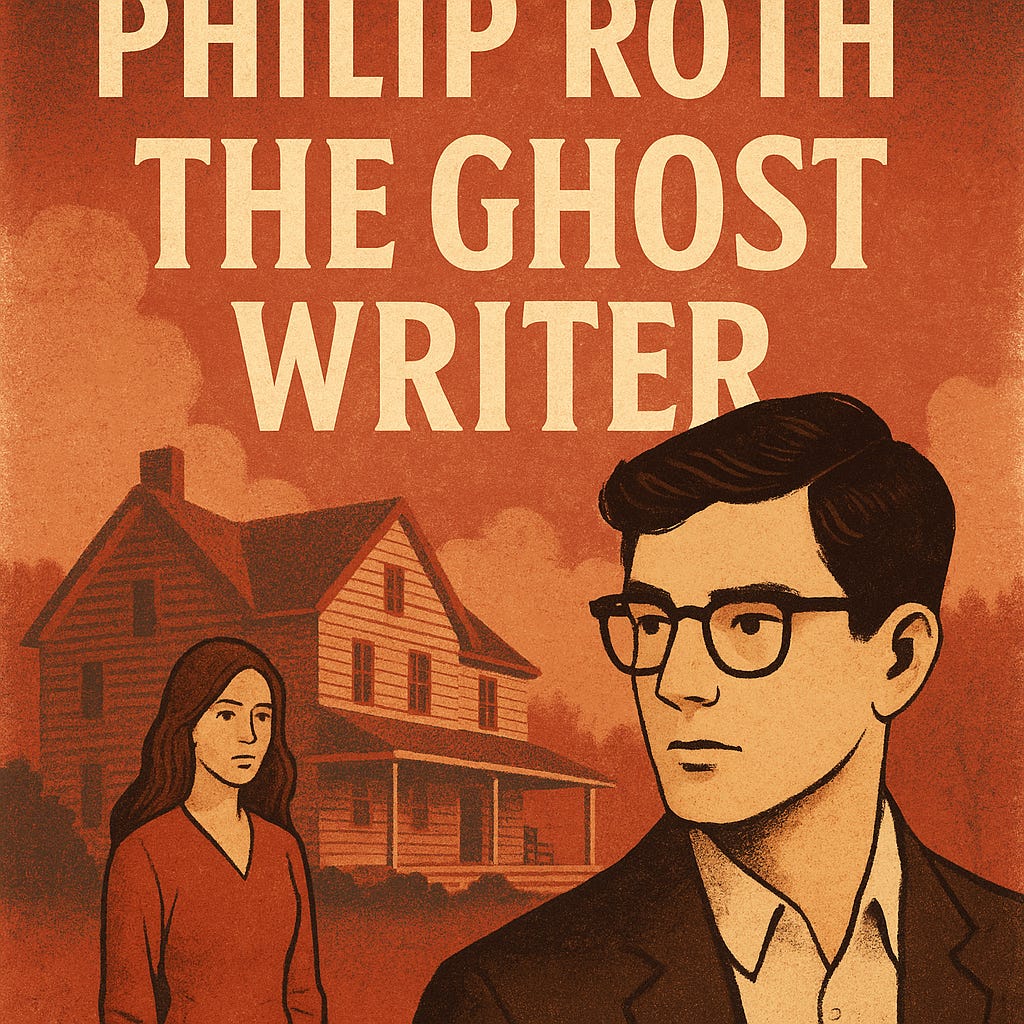
Philip Roth's The Ghost Writer is about an aspiring author who spends the night at the Lonoff estate. The Lonoff estate is a house out in the country owned by an established author, a one Mr. E. I. Lonoff, and his semi-estranged wife. The book takes place over the course of a night spent in a house and is largely plotless, but it manages to be touching and sad, but also riotously funny.
Roth spent most of his career writing about the Jewish experience in America in the way that only a true neurotic can. The thing that Roth does better than just about any other author is making his characters seem incredibly inward and self-aware, the sorts of people that could explain every element of their own psychosis and yet are still totally, completely under its sway. Mr. Lonoff has moved out into the countryside largely because of his fixation on his (supposedly) failing health and his driving his poor wife practically mad over the years with his bizarre, terroristic demands for peace and quiet, and his need for basic validation about his work. Mrs. Lonoff seems to be in the slow-motion process of leaving him, having become completely disillusioned with her husband and yet utterly convinced that she is the only one that can take care of him in the ways he needs and that if she were finally to force herself to leave him, he would drop dead within in a week She is essentially setting herself up as an extreme martyr to her tyrannical husband, who spends most of the story asking to be nagged slightly less than he is currently being nagged and responding to his wife’s histrionics with a knowing wink and an eye roll, which, as you can imagine, tends to make the whole thing worse. Mr. Lonoff finds his wife as ridiculous and self-indulgent as the reader, but is also unwilling to leave or to change (or admit that some of his own medical maladies are exaggerated or possibly even brought on by anxiety). Into this absolute mess, Nathan Zuckerman wanders into the house to ask Lonoff about the business of publishing and how he writes his books and if maybe Lonoff could put in a good word for him at the next industry shindig he attends, a request Lonoff is pretty coy about.
They also spend a fair bit of the book talking with each other about writer's block. Lonoff is apparently both between projects and working on several projects and complains that he is so busy writing he has no time for anything else, and that he is so busy with other things nowadays he has no time to write. Comparatively, Zuckerman is young and hungry and obsessed with writing and cannot understand Lonoff's hang-ups. The only thing that seems to compel him the way writing does is skirt-chasing. Lonoff laughs this off and tells him some stories about Flaubert and how he was unable to write for days at a time, wracked with indecision and questioning his abilities or about how Victor Hugo would have his servants hide his clothes so he couldn't go out until he had completed his self-appointed word-goals. For a guy who writes for a living, and managed to be quite successful in the doing, Lonoff seems less to be doing so out of a love of craft and a more generalized compulsion.
Zuckerman is pondering this when he meets for the first time Amy Bellette, another one of Lonoff's house-guests. She is a young woman who is only teriatirly interested in writing but is very educated and lively to talk too and Zuckerman pretty much immediately develops that specific ambivalent sort of feeling that men sometimes get around women they are drawn too but know are not going to reciprocate, as in fact Amy Bellette does not. Her presences is a source of fairly serious friction, because while Mrs. Lonoff is constantly poking at and provoking her husband, she doesn't want him getting any ideas and running around on her with, to pick a totally random example, the beautiful, vivacious, well-read woman who lives in his house and really, truly ‘gets’ his art in a wife that Mrs. Lonoff was never able too, being mostly a reader of romance novels and coffee table fiction.
The whole thing is pretty Freudian. Amy Bellette gets made into a fantasy woman. Zuckerman gets an immediate impression that Lonoff would not appreciate him making a move on Amy, a reaction that would appear to be motivated by a quasi-familial, father-daughter affection but would in reality have a lot more to do with a kind of male territorialism. Lions protecting their harem and all that. Amy probably would balk at the idea of being included in such a harem, but this really is less about her perceived or actual willingness to have a sexual relationship with either man and more about stature. Zuckerman isn't hitting on Amy (in front of Lonoff) for the same reason he wouldn't hit on a woman in front of his father, particularly if the woman in question was related to his father.
Of course, in this hypothetical, if Zuckerman was to hit on his father's daughter, there are some uncomfortable, incestuous implications to it. Roth is creating an entire adopted family dynamic that is defined by a Freudian sexuality and Faulkner-eusqe incest. Only after all this is established, dear reader, does it get truly weird when Nathan Zuckerman decides that Amy Bellette must be a pseudonym. Nathan begins to play with the idea in his mind, with some degrees of seriousness, that Amy Belette is actually Anne Frank, of diary fame.
This is ridiculous for a series of reasons. The book was contemporary to the year it was published, 1979, which makes it patently, chronologically impossible for Bellette to be some kind of deep cover for a holocaust victim. Not to mention the obvious questions; if Anne Frank were to survive the Nazi regime of extermination, why would she go into hiding as possibly the most famous victim of the SS? Why would she not be giving interviews or at least reuniting with her father, the only member of the Frank family to survive the extermination camps? Instead, Zuckerman, in a scene that is hard to read, listens to her through the wall while frantically masturbating and mixing in his mind his visions of Amy Bellette with his impressions of Frank.
It is at this point worth reminding the reader that the famous diary was written by a fourteen-year-old.
Roth seems to get a real kick out of stuff like this. Not necessarily all the overtly sexual weirdness, which is probably enough on its own, but also playing with tropes that seem dangerously close to anti-Semitic. This writer is hardly the first one to point out that the famous Roth-character archetype of the perverted neurotic Hebrew would probably be dismissed as a rather polemically negative take on Jewish people if it wasn't for that fact that Roth himself has the pass, so to speak. Even pointing out that a fair few Jews seem to hate themselves and get a kick out of self-depreciation has been well-documented in cultural stereotypes, going back to luminaries like fricking Shakespeare. Roth’s trademark analysis adds a hyper-masculine hero-fantasy to it, where Roth’s alter-ego seems to be fantasizing with some seriousness what it would be like to heroically save the picture of Jewish suffering, to be her knight in shining G.I.’s and to provide her with a life so cruelly cut short.
It’s a pretty standard male fantasy to be the big hero. It's less common for it to be so explicitly perverted and carnal. There is always the implication of sexual reward in the save-the-princess type of stories, but Roth takes it to a disturbing level. The fact that his fantasy alternates between quasi-incestuous and just totally bizarre is a rather dark look into the Rothian psyche.
This is sort of Roth’s schtick, though. A mix of Freudian psychoanalysis and raw shock value. The more interesting conversation is on the psychological damage wrought by the events of the 21st century and its impact on Jewish self-understanding.
It's hard to imagine Judaism without the global impact of the holocaust. It's one of those events that became the epoch defining moment for a generation. There is a profound difference in the American self-understanding before and after 9/11, before and after the events of Hiroshima and Nagasaki, before and after the entire Vietnam boondoggle. These events shape how Americans view their place in the world, the correct understanding of everything from foreign relations to internal policies to how we treat our neighbors. The Holocaust took a people that were unfortunately used to persecution and then proved beyond a shadow of a doubt that second-class citizens are still citizens, and that things can always get worse. Historically, it's also worth pointing out that of all the European nations that would be capable of something like this, Germany would be pretty low on the list. In eastern Europe, violent pogroms were a near-constant threat. In Palestine, violence had been consistently escalating for decades. America had long ago placed a tiny cap on Jewish immigration and wasn’t a great place to be for those who fit the cap. Germany had been a relatively nice place for the diaspora until a dude with a funny moustache and interesting ideas about who was really behind the threat of Bolshevism took power. From this lesson, a lot of the survivors decided that safety, true safety anywhere, would never be possible. That they would always be other-ized, marked out, a few bad years between life going on as normal or being herded into cattle cars.
So, what would having an apocalypse hanging over your head do to a people psychologically? What would a people genuinely convinced that at any point their door could be busted down by big fans of Hugo boss act like in their day-to-day? Well, for one thing, you might imagine they would be highly neurotic. You might also imagine that the past would have a way of influencing how they think around pretty much everything they might do, even things that are not exactly kosher. The reader really can feel the weight of history on the hapless denizens of Roth’s imagination, and it is a really interesting, funny, and tragic window into a very specific cultural malady.
The book ends with a famous fight. Mrs. Lonoff theatrically packs a bag and marches off down the road. The nearest shelter is something like three miles away and Mrs. Lonoff is a fat old lady and Mr. Lonoff responds by shrugging and explaining that she does this close to once a month and he will follow her in the car about a half-mile before he can coerce back into the car. Its either sweet or deeply frustrating, depending on your tolerance for nonsense. Zuckerman finds it deeply awkward, but also feels within himself a real sympathy for the poor couple. Mr. Lonoff is a demanding, hyper-critical man who is more than a touch self-absorbed, while Mrs. Lonoff is a perpetual matyre and a drama queen. In a way, they are made for each other, feeding off each other with their own flavors of mental illness. Zuckerman promises himself he will never be like them and then goes on to be nearly exactly like them over his next three books.